








Manufacturing businesses commonly compete based on a combination of three routes – focus on products and their performance, focus on the price of products, focus on a package of products, price and services. Deciding which route is the best depends on several forces such as the market dynamics and demand, technological change, internal organisational change and value network change. However, commoditisation of products overwhelmingly limits these options as competing on product and its performance is near impossible. There are several products in the market that look similar and perform similar to any other product. Competing on price can be difficult because the globally available low-cost methods of production exacerbate the effects of commoditisation and put immense pressure on profit margins. Theoretically, the only and best possible way to compete appears to be creating a package of high-performance products and customer-focused service sold on value-based pricing.
To test this theory, we asked businesses how they currently prioritise between these three routes, and how they think they will compete at some self-determined point in the future. Over a period of four years from 2018-2022, we received responses from 475 different individuals across the world. These individuals represented approximately 200 successful businesses. The pool included managing directors, financial directors, founders, CEOs, general managers, sales executives and marketing executives. The graphic below shows the average values of importance given to the three routes of product, price or package (now and in the future).
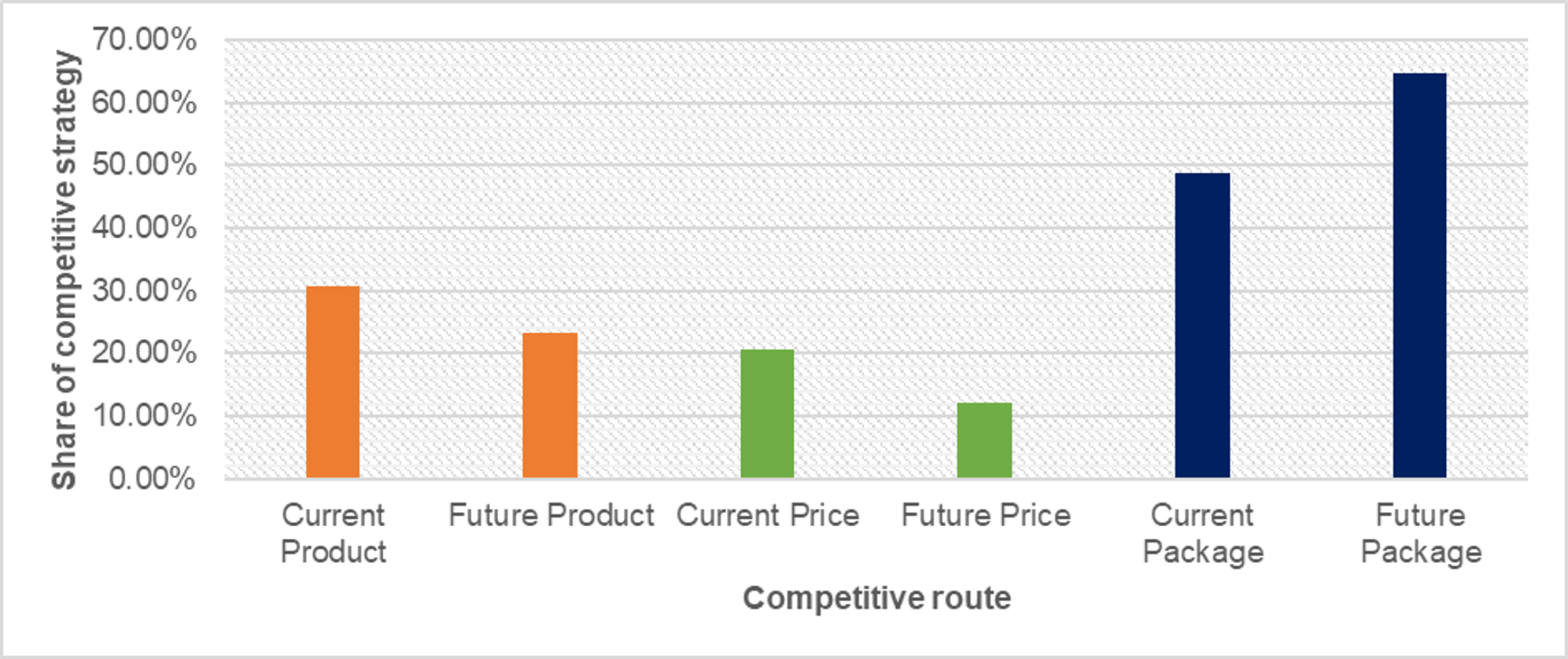
The graphic shows that all 475 respondents believe they have a competitive advantage because they prioritise the creation of an effective package over creating just a high-performance product, or through selling high-performance products at a lower price than their competitor. In the future, they believe the focus on package will become even more crucial. What does this mean for the wider manufacturing industry? It indicates one important trend:
Competing through services
These businesses are successful because they respond to customer needs through the delivery of a complex package of products and services. The services are the part most difficult to replicate in this package. Services allow the manufacturers to maintain long-term, and more intimate, relationships with the customers and the products after the sale is made. Businesses can engage the customers in long-term contracts revolving around the lifecycle of a product or beyond, based on the type of product. Such contracts help manufacturers understand how and why customers buy their products and the outcome they seek from using these products. This further unlocks new opportunities to create added-value through outcome-based services. The next graphic shows how manufacturers commonly build these services, step-by-step, as a portfolio.
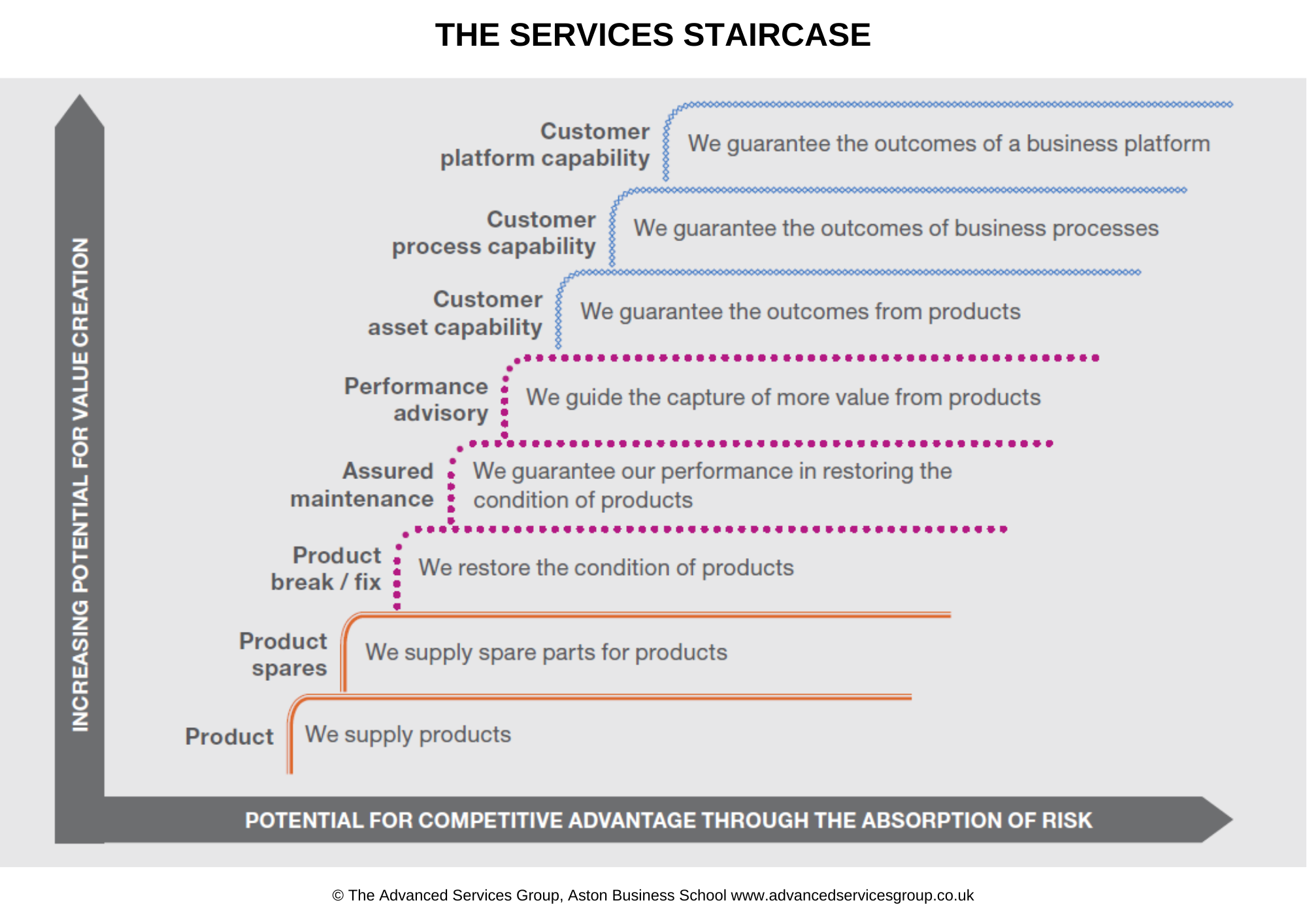
What does this staircase mean?
From the perspective of a ‘traditional’ manufacturer, where their history and reputation has been established from the sale of a product (asset), the lower part (orange) of the ‘Services Staircase’ reflects their offerings in the market. The next steps (purple) relate to the business’s involvement in the maintenance, repair, and upkeep of the products. Increasingly, the business starts getting closer to helping the customer extract maximum value and absorbing risks that it is best placed to manage. In the final steps of the staircase (blue), businesses provide guarantees around the product, the process in which the product operates, or the business platform that the product enables. As a business starts to explore what this staircase means to them in a services context, it becomes more conceptual and further away from their comfort zone. However, these complex services are viable as the manufacturer knows how to extract maximum value from the use of the product. Providing these services allows the businesses to increase the total share of value created between them and their customers, which results in improved ways to share that value among the involved stakeholders.
There are many successful examples of this, but particularly the example of Alstom Trains and Virgin is interesting.
Where should a business start?
There are 4 simple steps:
- Complete Unlock Your Insight
- Reflect up on the bespoke report that you will be sent to you by e-mail.
- Start to challenge where new opportunities for growth, through services, will come from.
- Purchase any of ASG’s miniguides to help you build your plan for transformation